UK LGBTQ+ News Round Up 9 August 2026: Single Sex Spaces Guidance, Pride Events And Political Rows
A factual UK LGBTQ+ news round up for the week ending 9 August 2026, covering the EHRC Code, trans rights legal action, London councils, Labour tensions, Brighton Pride and LGBTQ+ culture.

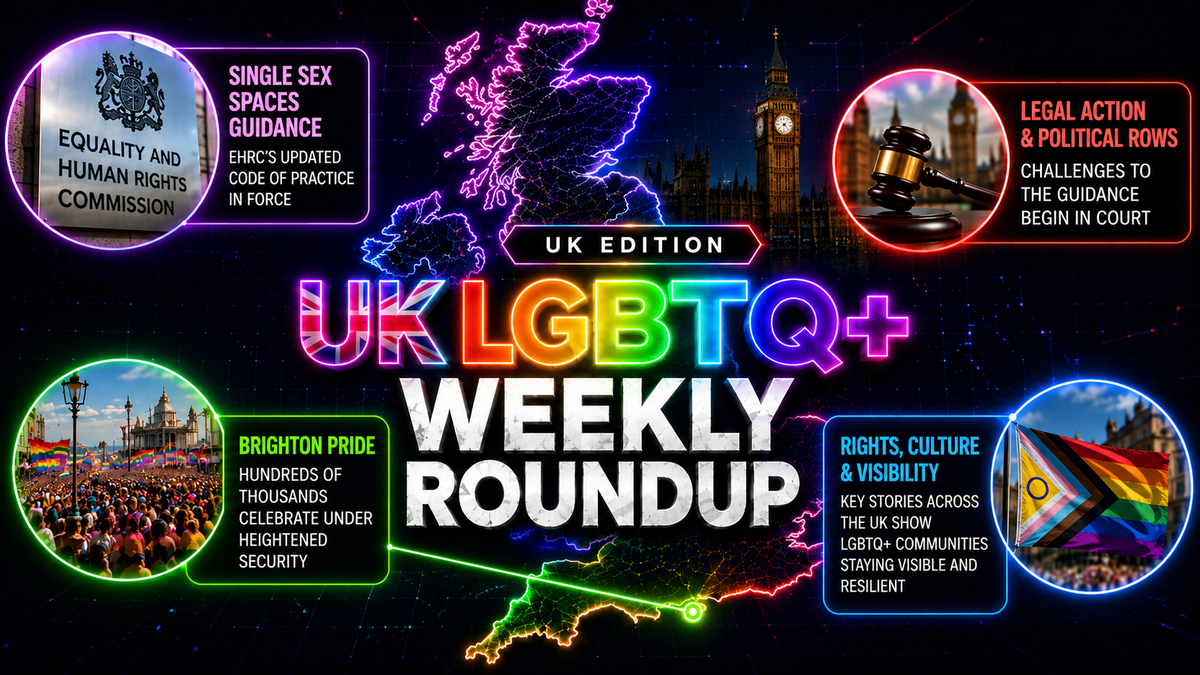
It has been another major week for LGBTQ+ news in the UK, with the EHRC’s updated Code of Practice coming into force, legal action beginning against the guidance, councils responding to the new rules, and Brighton Pride bringing hundreds of thousands of people together under heightened security.
This round up covers selected UK LGBTQ+ developments from 3 to 9 August 2026. The week was dominated by trans rights and public services, but there were also important stories around Pride, politics, culture and LGBTQ+ visibility.
EHRC Code Comes Into Force Across Great Britain
The biggest UK LGBTQ+ story of the week was the EHRC’s updated Code of Practice for services, public functions and associations coming into force on Wednesday 5 August.
The Code follows the UK Supreme Court ruling on the meaning of “sex” under the Equality Act 2010. The EHRC says the ruling means the terms “man”, “woman” and “sex” in the Act should be interpreted as biological sex for Equality Act purposes.
The new Code is statutory guidance, which means courts and tribunals can take it into account when deciding relevant discrimination cases. It applies to services and public functions across England, Scotland and Wales, including areas such as toilets, changing rooms, hospital wards, refuges and other sex separated spaces.
For trans people and LGBTQ+ organisations, the change has caused deep concern. Campaigners have warned that the guidance could make public life more difficult for trans people, especially if businesses, public bodies or frontline staff interpret it in a way that increases questioning, exclusion or uncertainty.
Supporters of the Code argue that it gives clearer guidance after the Supreme Court judgment. Critics argue that it risks making daily life less safe for trans people and could create confusion for service providers who now have to interpret sensitive legal and practical questions.
Legal Challenge Launched Against The Code
The new guidance is already facing legal pressure. The Good Law Project said it is supporting a legal challenge against the Government and the EHRC, arguing that the Code is unlawful and based on a wrong reading of the law.
A pre action letter has been sent as the first formal step before possible judicial review proceedings. The challenge is being brought on behalf of a trans person and a trans inclusive organisation, with the claimants arguing that the Code fails to protect trans people’s rights properly.
TransActual, Scottish Trans and the Trans+ Solidarity Alliance also published a joint statement as the Code came into effect. They warned that the guidance remains, in their view, unworkable and harmful, and urged organisations to consider carefully how they respond.
Scottish Trans also highlighted that the Code is likely to be relied on by organisations trying to understand their legal duties, while directing people towards support and monitoring resources. That response reflects the wider mood among trans rights groups, who are now focusing on both legal challenge and practical support.
The legal process will be important because it could shape how the Code is applied in practice. For now, the guidance is in force, but the dispute over its legality and real world impact is far from over.
London Councils Pledge Trans Inclusive Services
The EHRC Code also triggered a local government row after six London councils pledged to keep trans inclusive services despite the new guidance.
PinkNews reported that Lambeth, Hackney, Haringey, Lewisham, Southwark and Waltham Forest were among the councils taking that position. The councils argued that trans and non binary residents should continue to be treated with dignity and respect when accessing local services.
The issue has become politically sensitive because councils are now trying to balance legal guidance, local equality commitments and pressure from residents, campaigners and national politicians. Some critics argue that councils must implement the Code without delay, while supporters of the councils’ approach say local services should not become hostile or intimidating for trans people.
The row shows how the EHRC guidance is moving from national law and politics into everyday services. Councils, charities, leisure providers, venues and public bodies are now having to decide what the guidance means in practice for staff and service users.
That practical uncertainty is one of the main reasons this story is likely to continue. It is not only a Westminster issue. It affects local spaces where people work, swim, change, use toilets, seek support or access public services.
Labour Tensions Grow Over Trans Guidance
The EHRC Code also intensified tensions inside Labour. The Times reported a row involving Labour MP Samantha Niblett after she criticised the new guidance and argued in support of trans rights.
Her comments drew criticism from fellow Labour MP Tonia Antoniazzi, highlighting the continuing divide within the party over sex based rights, trans inclusion and how the Supreme Court judgment should be implemented.
This follows the previous week’s row over Labour Women’s Conference, where several Labour affiliated unions said they would boycott the event over the exclusion of trans women from formal proceedings.
Together, the two stories show that trans rights remain a live pressure point inside Labour politics. The issue is now cutting across government, MPs, unions, councils and campaign groups.
For LGBTQ+ readers, the political significance is clear. Decisions about public services, legal guidance and party rules are no longer abstract arguments. They are shaping how trans people are discussed in national politics and how public bodies are expected to respond.
Brighton Pride Brings Huge Crowds Under Heightened Security
Brighton and Hove Pride was another major UK LGBTQ+ story as the city marked the 35th anniversary of one of the country’s biggest Pride events.
The parade took place on Saturday 1 August, with reporting and reaction continuing into this round up period. ITV News reported that tens of thousands lined the streets as the parade moved through the city, while wider estimates suggested hundreds of thousands attended or took part across the weekend.
This year’s theme was “The Power of Love.” The event came after increased security planning following the deadly attack near Berlin’s Pride celebrations. Sussex Police had already confirmed that armed officers, plain clothed officers and specialist teams would be part of the policing operation.
The security focus did not take away from the scale of the celebration. Brighton Pride remains one of the UK’s most visible LGBTQ+ events, bringing together community groups, performers, charities, campaigners and visitors from across the country.
The weekend also featured major performers, including Raye and Diana Ross at Pride on the Park. For Brighton, the event was both a celebration of LGBTQ+ visibility and a reminder of the continuing need to keep Pride spaces safe.
Local Pride Events Continue Across The UK
Beyond Brighton, local Pride events continued across the UK during the week and weekend.
Wigan Pride returned with council backing and community involvement, while other Pride events listed for the wider period included Bingley Pride, Beverley Pride and Wakefield Pride. These smaller and regional events matter because they bring LGBTQ+ visibility into towns and cities beyond the biggest national Pride stages.
Local Pride events can sometimes be more important than they look from the outside. They give LGBTQ+ people, especially younger people, families and those outside major cities, a chance to see their community represented close to home.
They also show that Pride in the UK is not only about London, Manchester, Brighton or Birmingham. Smaller events continue to form a major part of the LGBTQ+ calendar, particularly at a time when national debate around trans rights and equality has become so heated.
LGBTQ+ Culture In Focus At London Film Festival Announcement
There was also a significant LGBTQ+ culture story this week as the BFI London Film Festival announced that Andrew Scott will open the festival with Elsinore.
Attitude reported that the film is based on the true story of Ian Charleson, the acclaimed Scottish actor who died from an AIDS related illness in 1990. The film is due to receive its European premiere at the 70th BFI London Film Festival in October.
The announcement matters because LGBTQ+ history and AIDS related stories continue to hold an important place in British cultural memory. Ian Charleson’s life and career remain significant not only because of his work, but because of the period in which he lived and died.
While the festival itself takes place later in the year, the announcement gave this week a notable LGBTQ+ arts story alongside the heavier political and legal coverage.
Northumbria Police dismissal draws fresh attention
Fresh attention has also focused on the dismissal of former Northumbria Police detective Rachel Fletcher, who was dismissed without notice on 31 July after a misconduct panel found gross misconduct proven over comments about men and transgender women, including one comment judged to be transphobic and offensive. Fletcher has since publicly challenged aspects of the decision and argued that some of her concerns were linked to police policies around the searching of transgender detainees. The case has added to the wider debate around workplace conduct, gender critical beliefs and the treatment of transgender people within public services.
What This Week’s UK LGBTQ+ Stories Show
This week’s UK LGBTQ+ news has been dominated by the EHRC Code and the response to it. The guidance coming into force marked a major moment in the legal and political debate over trans rights, public services and the meaning of sex under the Equality Act.
The legal challenge, statements from trans groups and responses from London councils show that the issue is not settled in practical or political terms. The Code is now in force, but its interpretation, impact and legality are still being contested.
Brighton Pride showed the other side of LGBTQ+ life in the UK: public celebration, visibility and community strength. At the same time, the increased security presence showed how Pride safety has become a more prominent concern after violence elsewhere in Europe.
The Labour row showed how deeply trans rights are now embedded in party politics, while local Pride events and the BFI announcement showed that LGBTQ+ visibility continues across culture, community and public life.
Together, these stories show a UK LGBTQ+ landscape under pressure, but still highly visible. The debate over trans rights is likely to remain the central story, but Pride, culture and community organising continue to provide important counterweights.
What To Watch Next
The key story to watch next is the legal challenge against the EHRC Code. Any response from the Government or the EHRC will be important, as will any decision on whether the case proceeds to a full judicial review.
Councils and public bodies are also likely to remain under scrutiny as they decide how to apply the guidance. Pride events will continue across August, while attention will also turn towards Manchester Pride and Bi Pride UK later in the month.
Disclaimer: This round up highlights selected major LGBTQ+ stories from 3 to 9 August 2026. Legal, policy, court and event details may change as official updates and reporting develop.
Sources note: Compiled from official material and reporting by GOV.UK, the EHRC, PinkNews, The Times, Good Law Project, Local Government Lawyer, TransActual, Scottish Trans, ITV News, The Independent, Brighton and Hove Pride, Wigan Council, Attitude and UK Pride event listings.