Global LGBTQ+ News Round Up 9 August 2026: Berlin Pride, WorldPride, US Trans Rights And Australia Census
A factual global LGBTQ+ news round up by continent for the week ending 9 August 2026, covering Berlin Pride, WorldPride Amsterdam, US LGBTQ+ politics, Senegal, Canada, Australia and wider rights pressure.

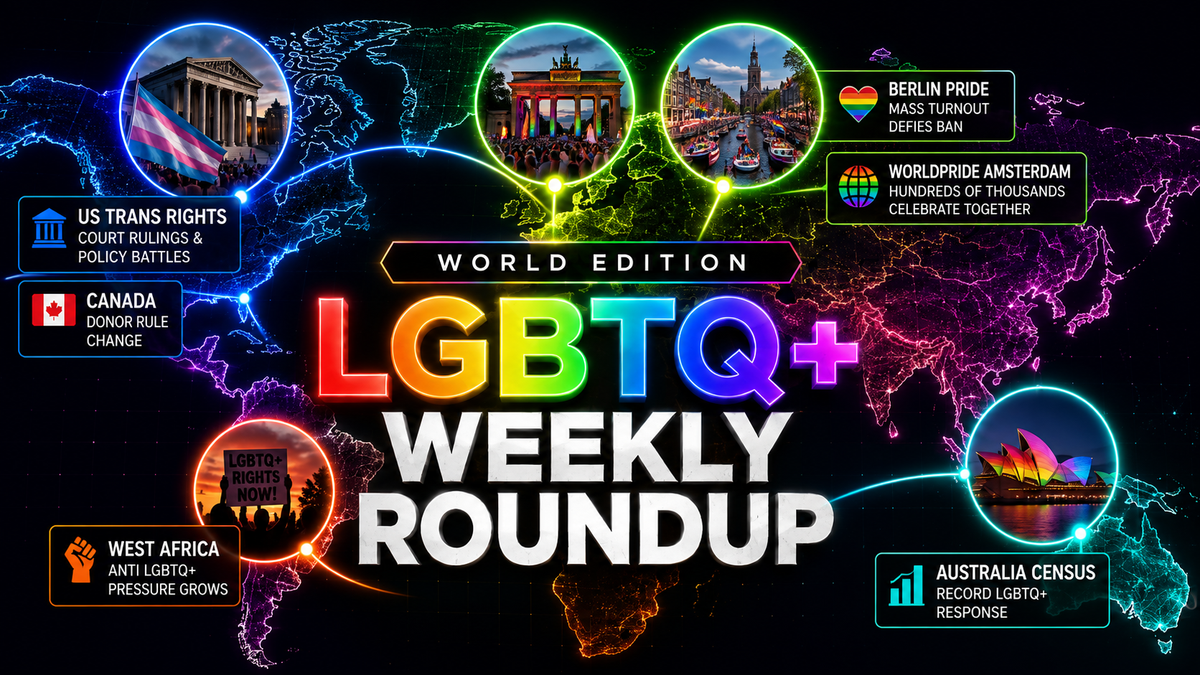
It has been another significant week for LGBTQ+ news around the world, with stories spanning Pride safety, WorldPride Amsterdam, US healthcare and education cases, Canada’s donor rule change, West Africa’s anti LGBTQ pressure and Australia’s census changes. This round up covers selected global LGBTQ+ developments from 3 to 9 August 2026, with recent context included where it directly shaped the week’s news.
Europe, North America, Africa and Oceania carried the strongest fresh stories, while Asia, Latin America and the Middle East were quieter for new headline developments. Those quieter regions remain important to the wider rights picture, especially where legal recognition, public safety and state policy are still under pressure.
Europe: Berlin Pride Aftermath And WorldPride Amsterdam
Europe’s LGBTQ+ news remained shaped by the aftermath of the Berlin Pride attack on 25 July. German authorities said a 21 year old suspect drove a van into crowds near Christopher Street Day, killing one woman and injuring 29 people, before later being shot dead by police.
The attack continued to affect Pride safety discussions across Europe. German officials treated it as an Islamist extremist terror attack, and the fallout shaped security planning at other major LGBTQ+ events, including Brighton Pride in the UK and WorldPride Amsterdam in the Netherlands.
Amsterdam hosted the final week of WorldPride and EuroPride 2026, with the Human Rights Conference running from 5 to 7 August and the WorldPride March and closing concert taking place on 8 August. The event carried added symbolic weight because the Netherlands is marking 25 years since becoming the first country in the world to open civil marriage to same sex couples.
AP also reported on a “Married For A Day” Pride event in Amsterdam on 6 August, where people joined a symbolic mass wedding as part of the celebrations. Dutch Prime Minister Rob Jetten, the country’s first openly gay leader, was also part of the wider WorldPride story as organisers and political figures used the event to highlight freedom, safety and equality.
The wider European rights picture remains uneven. ILGA Europe’s 2026 Rainbow Map placed Spain at the top of its ranking for the first time, ending Malta’s ten year run in first place, while Russia remained at the bottom amid continuing repression of LGBTI organisations under an extremist designation.
North America: US Healthcare, New York Bathhouses And Canada Donor Rules
In North America, one of the biggest legal stories came from the United States, where federal employees sued the Trump administration over a ban on health insurance coverage for gender affirming care. Reuters reported on 3 August that five anonymous government workers filed a proposed class action in Washington, DC.
The lawsuit is new this week, but the policy background is older. The challenged coverage ban took effect in January, following wider Trump administration action on sex and gender policy, with the Office of Personnel Management later setting the health benefits approach for federal employee plans.
The lawsuit argues that the policy discriminates on the basis of sex under Title VII of the Civil Rights Act. It focuses on federal employee health insurance and coverage for treatment such as hormone therapy and some surgeries when used for gender transition.
New York also saw a major public health and LGBTQ+ history story. LGBTQ Nation reported on 7 August that state senator Erik Bottcher introduced Senate Bill S10673, the Public Health Modernization Act, with support from assembly member Tony Simone.
The bill seeks to repeal a 1985 law restricting bathhouses and adult venues, introduced during the HIV and AIDS crisis. Supporters argue that the public health landscape has changed and that regulated adult venues can now be approached through modern harm reduction, testing and sexual health practice.
Canada also saw a significant LGBTQ+ health policy development. Health Canada ended remaining restrictions affecting gay and bisexual sperm donors, removing sexual behaviour screening questions that campaigners said continued to disproportionately affect men who have sex with men.
North America: Trump Remarks, Texas A&M Lawsuit And Hadestown Exit
US politics also kept trans rights in the headlines. LGBTQ Nation reported that Donald Trump went off script during a White House event for Winter Olympians and Paralympians, using remarks about trans athletes to claim that a judge had declared sports unconstitutional.
The comments were widely shared because they showed anti trans sports rhetoric continuing at the highest level of US politics. They also came against the wider background of court rulings and state campaigns over trans participation in school sport.
Education and academic freedom became another part of the US LGBTQ+ picture. The Houston Chronicle reported on 4 August that professors had sued the Texas A&M University System over limits on teaching race, gender and sexual orientation, with one professor saying LGBTQ+ material including Moonlight and Trans Generation had been removed from a course.
There was also a Broadway culture story after Geno Segers exited Hadestown. People and Entertainment Weekly reported that the actor and the production parted ways after resurfaced videos about transgender people prompted backlash before his planned Broadway debut.
Africa: Senegal And West Africa Remain Under Pressure
Africa’s most important LGBTQ+ story remained the continuing rise of anti LGBTQ lawmaking across West Africa. The Guardian reported on 2 August that campaigners were warning of a regional pattern, with Senegal, Niger, Mali, Burkina Faso and Ghana among the countries highlighted.
Senegal remains especially important. A constitutional amendment that would have written an opposite sex definition of marriage into the constitution was struck down by the Constitutional Council in July, but the ruling was procedural and linked to presidential powers rather than a positive LGBTQ+ rights decision.
That distinction matters. The court blocked that specific constitutional change, but Senegal’s broader anti LGBTQ legislative pressure has not disappeared, and campaigners remain concerned about criminalisation, public hostility and the impact on HIV prevention and legal support.
The wider regional picture is serious. Rights groups have warned that anti LGBTQ laws and “family values” campaigning can push people away from healthcare, housing support, legal advice and community services.
Asia: Japan And Thailand Show Different Regional Paths
Asia was quieter for major fresh LGBTQ+ headlines inside this exact week, but two ongoing stories remain important. Japan’s Supreme Court Grand Bench is expected to issue a unified ruling on the constitutionality of the country’s same sex marriage ban, possibly in 2027.
Japan remains the only G7 country without marriage equality or national civil partnerships, and lower courts have already produced rulings putting pressure on the national government. The Supreme Court process is therefore one of the most important LGBTQ+ legal stories to watch in Asia.
Thailand, by contrast, continues to position itself as a regional LGBTQ+ hub after marriage equality took effect. Bangkok Pride 2026 earlier this year was promoted by the Thai government as part of the country’s wider equality and tourism strategy.
These two stories show very different directions within the region. Japan is still waiting for national legal recognition, while Thailand is using marriage equality and Pride visibility as part of its international identity.
Latin America: Quieter Week, But Argentina Remains Key Context
Latin America was quieter for fresh LGBTQ+ headlines during this round up period, but recent developments in Argentina remained relevant. A federal court suspended President Javier Milei’s decree restricting gender affirming care for trans children and adolescents in July.
That decision restored protections under Argentina’s Gender Identity Law while the legal challenge continues. The story did not break inside this week’s exact window, but it remains one of the most important recent LGBTQ+ rights developments in the region.
Across the wider region, the picture remains mixed. Countries including Argentina, Uruguay, Brazil and Mexico have important LGBTQ+ legal protections, but campaigners continue to warn about violence against trans women and gender diverse people.
This is why quieter weeks still matter. A lack of a major new court ruling does not mean LGBTQ+ safety is settled, especially in regions where legal progress and everyday risk often exist side by side.
Oceania: Australia Census And NSW Hate Speech Decision
In Oceania, Australia’s 2026 Census became one of the most important LGBTQ+ stories of the week. The census takes place on 11 August and will ask people aged 16 and over new questions about sexual orientation and gender.
The Australian Bureau of Statistics has said the questions will help build a clearer picture of LGBTQ+ communities and support planning for services. LGBTQ+ advocates have welcomed the change, although reporting has noted that intersex status will not be captured in the same way.
Australia also saw debate in New South Wales after the state government rejected a recommendation to expand hate speech law protections to include religion, sexual orientation and gender identity. Equality Australia criticised the decision, arguing that it denied LGBTQ+ communities equal protection.
In New Zealand, puberty blocker restrictions remained under judicial review following earlier court action. The High Court had already ordered that the Crown should not enforce the regulations while the legal process continues, keeping the issue live even during a quieter week for fresh LGBTQ+ headlines.
Middle East: Quieter Week For Fresh LGBTQ+ Headlines
The Middle East was quieter for fresh LGBTQ+ headlines during this round up period, so there was no major new regional development to place alongside the week’s larger stories from Europe, North America, Africa and Oceania. Recent World Cup coverage has kept Egypt, Iran and Saudi Arabia in wider LGBTQ+ rights discussions, but the most prominent Pride Match row involving Egypt and Iran was a Seattle hosted fixture from late June, rather than a new Middle East story from this week.
Saudi Arabia’s future hosting of the 2034 World Cup also remains relevant background for LGBTQ+ travel and sport safety, because rights groups continue to raise concerns about restrictions on LGBTQ+ expression. For this week’s round up, however, the region is best treated as context rather than a fresh news section.
What This Week’s Global LGBTQ+ Stories Show
This week’s global LGBTQ+ news shows how Pride, policy and public safety are now tightly connected. Europe’s week was shaped by grief after Berlin and visibility in Amsterdam, while North America showed the contrast between public health reform, political rhetoric and LGBTQ+ cultural accountability.
Africa’s stories showed that legal pressure is still rising in parts of West Africa, even where courts intervene on procedure. Asia showed two different paths, with Japan still awaiting national recognition and Thailand using marriage equality as part of its global identity.
Latin America and Oceania showed how rights can be strengthened or tested through courts, data and healthcare policy. The Middle East was quieter for new headlines in this round up period, but global sport and travel safety continue to keep the region in wider LGBTQ+ rights discussions.
The common thread is that LGBTQ+ visibility remains powerful, but uneven. In some places it is celebrated, counted and protected, while in others it is restricted, politicised or treated as a threat.
What To Watch Next
Australia’s 11 August Census will be one of the next major stories to watch, especially how LGBTQ+ communities respond to the new questions and remaining gaps. The aftermath of WorldPride Amsterdam is also likely to shape global Pride and human rights coverage.
In the United States, the New York bathhouse bill, federal worker healthcare lawsuit, Texas A&M case and anti trans sports rhetoric are likely to continue. In Africa, campaigners will be watching whether anti LGBTQ proposals in West Africa continue to spread or face further legal and political challenge.
Disclaimer: This round up highlights selected global LGBTQ+ stories from the week ending 9 August 2026, with clearly labelled recent context where relevant. Legal, policy, court and event details may change as official updates and reporting develop.
Sources note: Compiled from official material and reporting by AP, Reuters, The Guardian, LGBTQ Nation, People, Entertainment Weekly, ILGA Europe, Human Rights Watch, Amnesty International, The Japan Times, the Australian Bureau of Statistics, Guardian Australia, WorldPride Amsterdam, Pride Amsterdam, MambaOnline and LGBTQ+ rights sources.