China’s AI Actors Spark Backlash Over Jobs, Likeness and the Future of Human Performers
China’s new AI actors Qin Lingyue and Lin Xiyan have sparked debate over jobs, celebrity likeness rights and whether virtual performers could reshape television.


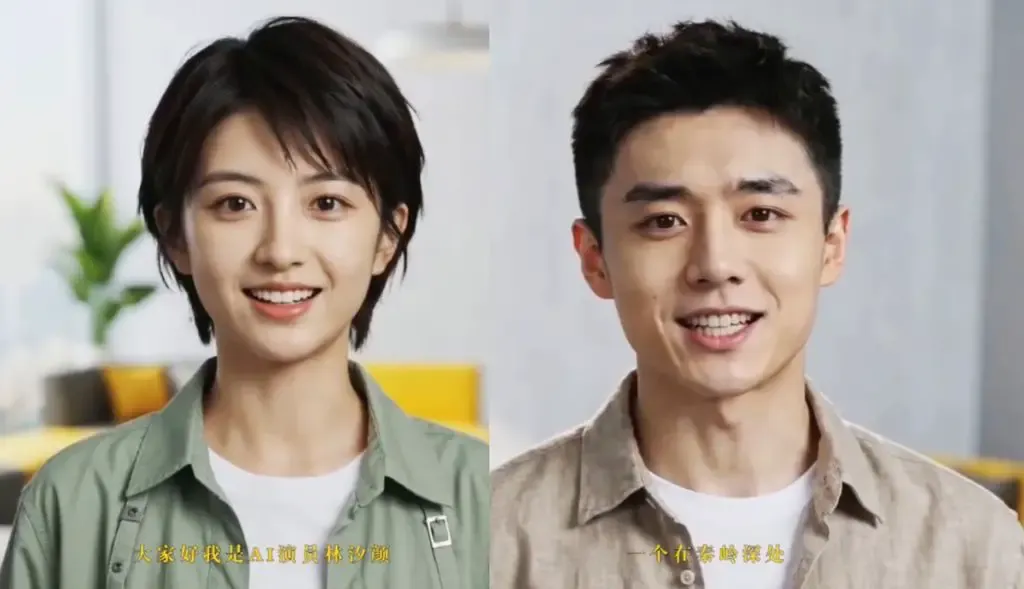
China’s rapidly expanding artificial intelligence entertainment industry has produced two new stars, but neither of them is human. Qin Lingyue and Lin Xiyan are AI-generated performers created for a short-form drama, and their arrival has reopened some of the biggest questions facing actors around the world.
The controversy is not simply about whether audiences will accept computer-generated characters. Critics are questioning whether virtual performers could reduce opportunities for human actors, how creators can prove an AI face is genuinely original, and what happens when a synthetic character looks recognisably similar to a real person
Who are Qin Lingyue and Lin Xiyan?
Shanghai-based production company Youhug Media unveiled Qin Lingyue and Lin Xiyan as AI performers in March 2026. The pair were introduced with their own identities and social media presence rather than being presented simply as digital effects within a programme.
They were created to appear in a 60-episode short drama commonly translated into English as The Qinling Bronze Occult Chronicles. Episodes run for only a few minutes, following characters who travel back to ancient China in a story connected with the country’s Bronze Age.
Qin plays a former soldier involved in an archaeological adventure, while Lin appears as a geologist with her own hidden mission. Their creators can control their appearance and performances digitally, removing many of the physical limitations associated with casting and filming human actors.
That is precisely what has made them significant. Virtual characters have existed for years, particularly in animation and gaming, but presenting AI-generated creations as named “actors” places them much closer to the traditional performer economy.
Why did the AI actors cause a backlash?
Almost immediately, online discussion moved towards the appearance of the two characters. Some viewers argued that Qin resembled Chinese actor Zhai Zilu, while Lin was compared with actresses including Zhao Jinmai and Zhang Zifeng.
Those comparisons do not prove that either performer’s likeness was copied or used during production. Youhug Media has said the characters were generated without copying or using the facial features of any real individual.
The dispute nevertheless exposes a difficult problem for increasingly realistic AI characters. A studio may intend to generate a completely original face, yet audiences can still perceive similarities with existing performers once thousands of possible facial characteristics are combined.
That creates both an artistic and potentially legal question: at what point does resemblance become identifiable likeness?
China already protects a person’s likeness
China’s Civil Code provides legal protection for a person’s portrait or likeness as part of their personality rights. It prohibits organisations and individuals from infringing those rights through methods including falsifying someone’s image with information technology and generally prevents a person’s image being made, used or published without consent, subject to legal exceptions.
This means the arrival of realistic AI performers is happening within an existing legal framework rather than an entirely unregulated space. Chinese courts have also already considered disputes involving artificial intelligence and identifiable human characteristics.
In one significant case involving an AI-generated voice, a court found that a voice could remain protected where listeners were still able to identify the original person through characteristics such as tone, pronunciation and speaking style. China’s Supreme People’s Court later highlighted the case when discussing protection of personality rights in the age of AI.
Faces and voices are not identical legal questions, but the principle is important for entertainment. Generative technology does not necessarily remove a person’s rights simply because the final result has passed through an AI system.
The bigger fear is what happens to human jobs
The strongest reaction to Qin and Lin has gone beyond their appearance. For actors and other entertainment workers, the concern is what widespread adoption of synthetic performers could eventually mean for employment.
A traditional production employs far more people than the stars visible on screen. Casting teams, costume and make-up departments, camera crews, lighting teams, assistants and many other workers are involved in bringing performances to life.
AI does not automatically eliminate all of those jobs. Digital productions still require writers, designers, directors, editors, technologists and other creative workers, and new forms of production can create different roles of their own.
However, the economics are difficult to ignore. If studios can make certain forms of entertainment more quickly and cheaply with generated environments and performers, some jobs could change while others may disappear. Exactly how large that effect becomes remains uncertain and will depend heavily on how the technology is adopted.
China’s AI short-drama market is already growing quickly
This debate matters because short-form AI entertainment in China is no longer a tiny experiment. Micro-dramas, which tell stories through very short episodes designed primarily for mobile viewing, have become a major entertainment business.
Industry data from DataEye indicates that AI-powered comic-style or animated short dramas represented around 38 per cent of the top 100 titles in that particular category in January 2026, compared with around 7 per cent a year earlier. The statistic should not be interpreted as meaning that 38 per cent of all Chinese television drama now uses AI actors, but it shows how quickly AI-heavy production is growing in one important part of the short-form market.
Generative technology is particularly suited to this format because producers need large volumes of material at speed. Short episodes, digital distribution and audiences accustomed to highly stylised storytelling can make experimentation considerably easier than it would be on a conventional hour-long television drama.
Qin and Lin therefore represent something larger than two unusual characters. They are appearing while an entire entertainment format is testing how far synthetic production can go.
Audiences will also decide whether AI actors succeed
Technology can create a face, generate dialogue and produce an increasingly convincing performance, but that does not guarantee viewers will form the same relationship with a virtual actor that they do with a human performer.
Human actors bring their own experiences, personalities and public identities to their work. Audiences follow careers across different productions, watch interviews, connect performances with real lives and sometimes remain invested in performers for decades.
AI characters could develop another kind of following, particularly if they maintain social media identities and interact with audiences outside individual programmes. Their creators can also potentially keep them permanently available, change their age and appearance, and place them into new stories without the practical restrictions faced by a human performer.
Whether viewers see that flexibility as exciting or artificial will become an important part of the experiment.
AI actors make the rights debate harder to avoid
China has also introduced rules requiring AI-generated and synthesised online content to carry appropriate labelling, including visible and technical forms of identification in circumstances covered by the regulations. The measures came into force in September 2025 and are intended to make synthetic content easier to recognise and trace.
Labelling helps answer one question by telling audiences that something was generated or altered using AI. It does not answer the harder questions about who inspired a digital face, what material was used to create it, who owns the resulting character or what happens to performers whose work becomes less valuable as synthetic alternatives improve.
Qin Lingyue and Lin Xiyan may ultimately become successful virtual stars, disappear as a short-lived experiment or help establish an entirely new category of performer. Their importance right now is that they make a previously theoretical debate much more visible.
The entertainment industry no longer has to imagine what happens when studios start creating their own actors. In parts of the market, that process has already begun, and the argument is shifting towards what rules should govern the people, performances and jobs that remain human.
Sources: Youhug Media’s public announcement of Qin Lingyue and Lin Xiyan and information surrounding The Qinling Bronze Occult Chronicles, DataEye industry figures on AI-generated short-form drama, the Civil Code of the People’s Republic of China.
For more on how artificial intelligence is changing performers, production and the wider entertainment business, visit SoapLandTV’s AI & Entertainment hub, including our Industry & Debate, AI Films, AI Animation and Behind the Technology coverage.