High Tides Creator Fernanda on Clara, Valerie and the WLW Story Growing Beyond the Page
High Tides creator Fernanda talks exclusively to SoapLandTV about Clara and Valerie, their WLW love story, visual storytelling, readers and what the characters mean to her.


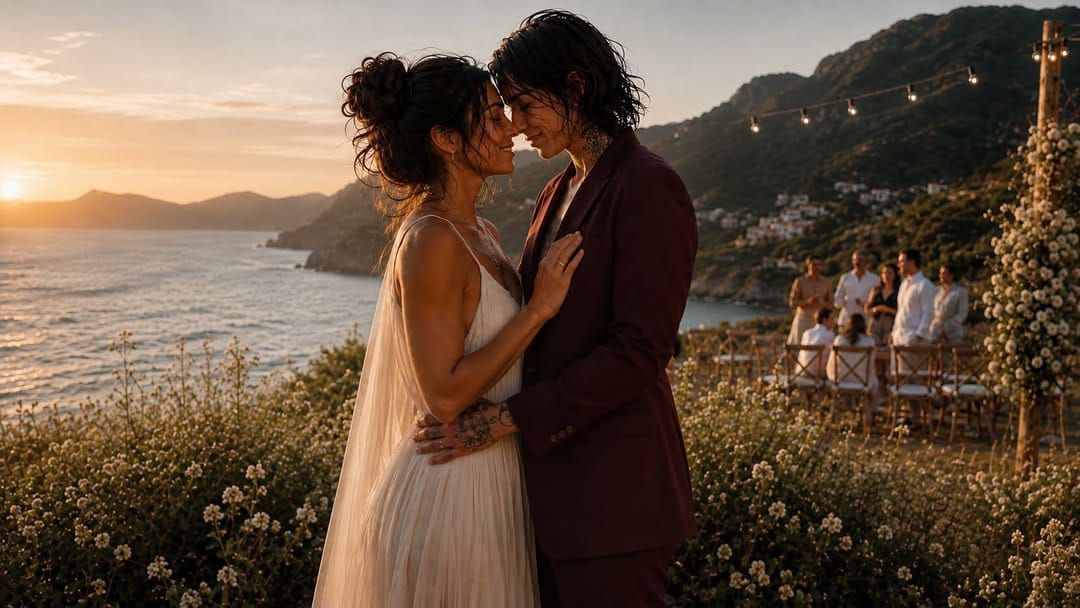
Clara and Valerie may have started life as two fictional characters, but the world surrounding High Tides has grown into something much bigger. Readers now follow their relationship through the written story as well as the images, short videos and smaller moments that allow the pair to exist beyond the boundaries of individual chapters. At the centre of all of it is creator Fernanda, who has spent years developing Clara and Valerie while watching an international online community begin to care about them too
Their story has explored love, illness, recovery, fear, intimacy and the ordinary moments between the drama, while the growing visual side of High Tides has created another way for people to discover the characters.
In this exclusive SoapLandTV interview, Fernanda talks in depth about the women behind High Tides, the reactions that have surprised her, the extraordinary amount of thought that can go into a single look or kiss, and why the ocean was part of Clara and Valerie’s story before she fully understood what that story would become.
Clara and Valerie clearly mean a lot to your readers, but what do they mean to you personally now, compared with when you first started writing them?
When I first started writing Clara and Valerie, I already knew who I wanted them to be. I knew their personalities, their strengths, their flaws, the way they would challenge each other, and the kind of relationship I wanted to build between them. They were never blank pages that I discovered as I went along. What I couldn’t have known was what writing them for this long would eventually mean to me. Over time, I’ve taken them through things I never imagined when I first created them, and in doing that, they’ve given me a way to explore fear, love, grief, courage, scars, survival, and the quiet, ordinary moments that make a life worth living.
And somewhere in all of that, something unexpected happened to me too. Writing them sometimes helped me understand feelings or ideas I hadn’t quite known how to put into words before. But Clara is still Clara. Valerie is still Valerie. The core of who they are was there from the beginning. What changed was how much history they accumulated, how many sides of them I had the chance to explore, and how much they came to mean to me after living with their story for so long. And then there was something else I could never have planned: other people started caring about them too.
Readers brought their own experiences to Clara and Valerie. They worried about them, laughed with them, got angry with them, wanted to protect them, and found their own meanings in moments I had written. I think that’s the biggest difference between then and now. When I started, Clara and Valerie were two characters whose story I knew I wanted to tell. They still are. I just had no idea how many people would eventually want to stay and listen.
Was there a moment while writing their story when one of them surprised you - when a character suddenly became different from the person you originally imagined?
Clara. Without question. Not because she became a different character from the one I originally imagined, but because life forced her to become a different version of herself. When I created Clara, so much of her identity was connected to strength, discipline and independence. She was a personal trainer, former military, someone who trusted her body and was used to being the person who could handle things. She took care of other people and rarely needed anyone to take care of her. Then I gave her a heart condition.
At first, I thought I was writing about Clara surviving it - getting her through the diagnosis, the fear, the surgery and the recovery. But eventually I realized I was writing about something much harder: what happens when you survive, but you can’t simply go back to being the person you were before? Clara had built so much of her identity around being capable, useful and in control. Suddenly, she had to live inside a body she didn’t completely trust anymore. She needed help. She was scared. And many of the things she had always used to answer the question “Who am I?” were temporarily - and sometimes permanently - taken away from her. That didn’t make her stop being Clara.
It forced me to explore who Clara would be when so many of the things she had always relied on were no longer available to her. And that’s when I fell in love with her as a character in a completely different way. Her strength stopped being only about how much she could carry or endure. Sometimes strength became asking for help. Sometimes it was admitting “I’m scared.” Sometimes it was allowing Valerie to take care of her instead of always being the one taking care of everyone else. The Clara I write now carries things the Clara at the beginning hadn’t lived through yet.
But underneath all of that, she’s still the woman I created from the beginning. She just had to learn that what made her her had never really been the things she was capable of doing.
What is something about Clara and Valerie’s relationship that readers seem to understand instinctively, even when you never explicitly explain it on the page?
I think readers understand that Clara and Valerie have a language that exists underneath the dialogue. They don’t constantly tell each other “I love you,” and they’re not a couple who makes big declarations of love all the time. That’s very intentional. If they did, I think they would stop feeling like Clara and Valerie to me. Their “I love you” is usually somewhere else.
It’s in Valerie noticing that Clara has gone quiet before Clara says anything. Clara knowing when to make Valerie laugh and when not to ask another question. A hand reaching for the other one without thinking. Making coffee. Sitting together in silence. Teasing each other about something silly. Readers seem to understand that language instinctively. Sometimes I’ll write the smallest gesture between them and people react to it more strongly than they do to a huge dramatic scene. I love that, because it means I don’t have to explain what every touch or silence means. They already know them well enough to hear what they’re saying without words. And I think they understand something else too: their relationship has never really been about saving each other.
It’s about staying. There have been things Valerie couldn’t fix for Clara, and things Clara couldn’t protect Valerie from. Their love had to exist without the promise that one of them could always make everything okay. Sometimes all they can offer is: “I can’t fix this, but I’m here.” Those quiet moments aren’t pauses between the important parts of their story. They are the important parts. Clara and Valerie don’t need to say “I love you” constantly because, hopefully, by now the reader can recognize all the other ways they say it.
Your Instagram makes High Tides feel almost like a place people can step into. When you create a new visual, scene or video, what feeling are you trying to leave people with?
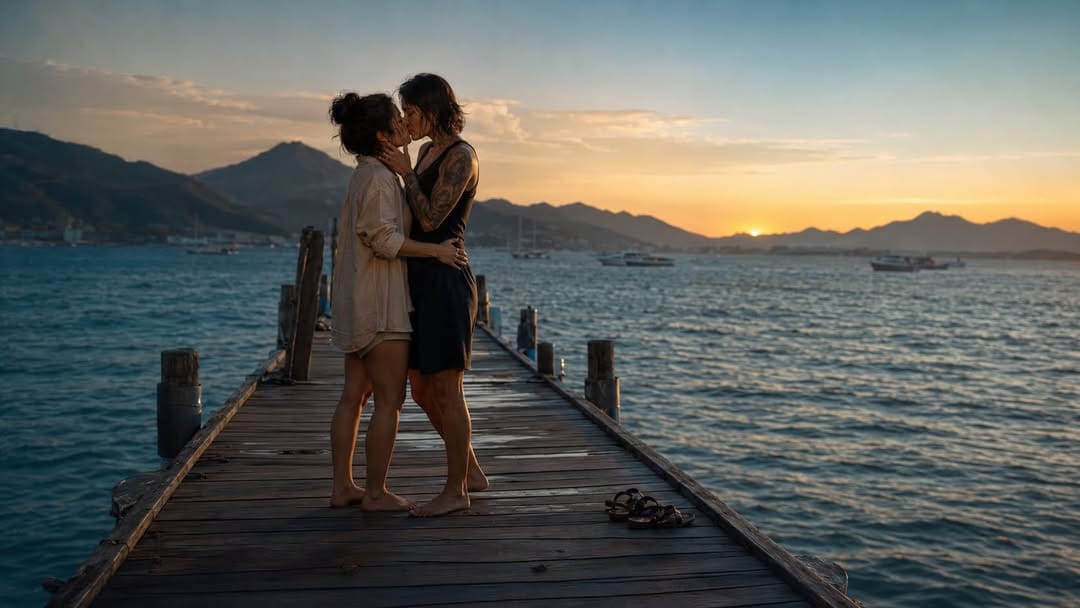
I want people to feel something. It doesn’t necessarily have to be beautiful. Sometimes I want them to laugh. Sometimes I want their heart to hurt a little. Sometimes I want them to feel uncomfortable, relieved, afraid, nostalgic, or happy over two women doing absolutely nothing important in a kitchen. What I don’t want is for someone to just look at a visual and think, “Oh, that’s a nice image.” And I don’t want Clara and Valerie to be reduced to something sexual just because there’s intimacy or desire between them. Of course that side of their relationship exists. Desire is part of it, and I don’t want to erase that either. But when they kiss, touch or look at each other, I want there to be something beyond physical attraction. History. Trust. Fear. Tenderness. Sometimes even things I deliberately leave unnamed.
I want people to feel what exists between them, not just see what they’re doing. For me, the visual side of High Tides was never really about illustrating the story. I want it to feel like you’ve stepped inside it for a few seconds. I want you to hear the ocean even if there’s no sound. Feel how quiet everything is at 5 a.m. Understand from Valerie’s face that something is wrong before anyone says it. Feel the warmth after dinner, or that horrible second when Clara is scared and trying very hard not to show it. That’s why the tiny details matter so much to me: the light, the way someone is standing, where a hand is, whether they’re looking at each other or deliberately not looking at each other.
And as the community has grown, there’s another feeling I’ve started to love: returning. People know the ocean. They recognize the atmosphere of this world and what certain looks between Clara and Valerie mean. So sometimes when I create something new, I don’t feel like I’m introducing them to a place. I’m opening the door and letting everyone back in. If someone watches one of those little videos and, for ten seconds, forgets where they are because they’re there with Clara and Valerie… then it worked.
Do you ever create a visual and then realise it has changed the way you see a character or scene in the actual story?
Yes, although I think “changed” works a little differently for me. A visual has never changed who Clara or Valerie is in the story. I already know who these women are, and if I create something that doesn’t feel true to them, the visual is the thing that has to go. But visuals have definitely made me see things differently.
Sometimes I see a gesture, the distance between them, or the way one of them is looking at the other, and something I already understood about the character suddenly becomes visible in a different way. Clara’s scar is probably a good example. I already knew what that scar meant to her and what she had lived through to carry it. But writing about that history and then actually seeing it permanently present on her body are two different experiences. It made me think more about how that history remains physically present even in moments that have nothing to do with her heart. Recovery doesn’t return her body to a blank page.
And sometimes a visual gives me a tiny emotional detail that follows me back into the writing - a gesture, a silence, a particular way Valerie watches Clara when Clara isn’t looking. It doesn’t redefine the character. It gives me another way of looking at something that was already there. And I love those moments when I look at something I’ve created and think: “Oh… I knew that about you. I just hadn’t seen it like that before.”
What has been the most unexpected reader reaction you’ve had to Clara and Valerie, something that genuinely made you stop and think, “wow, people really care about these two”?
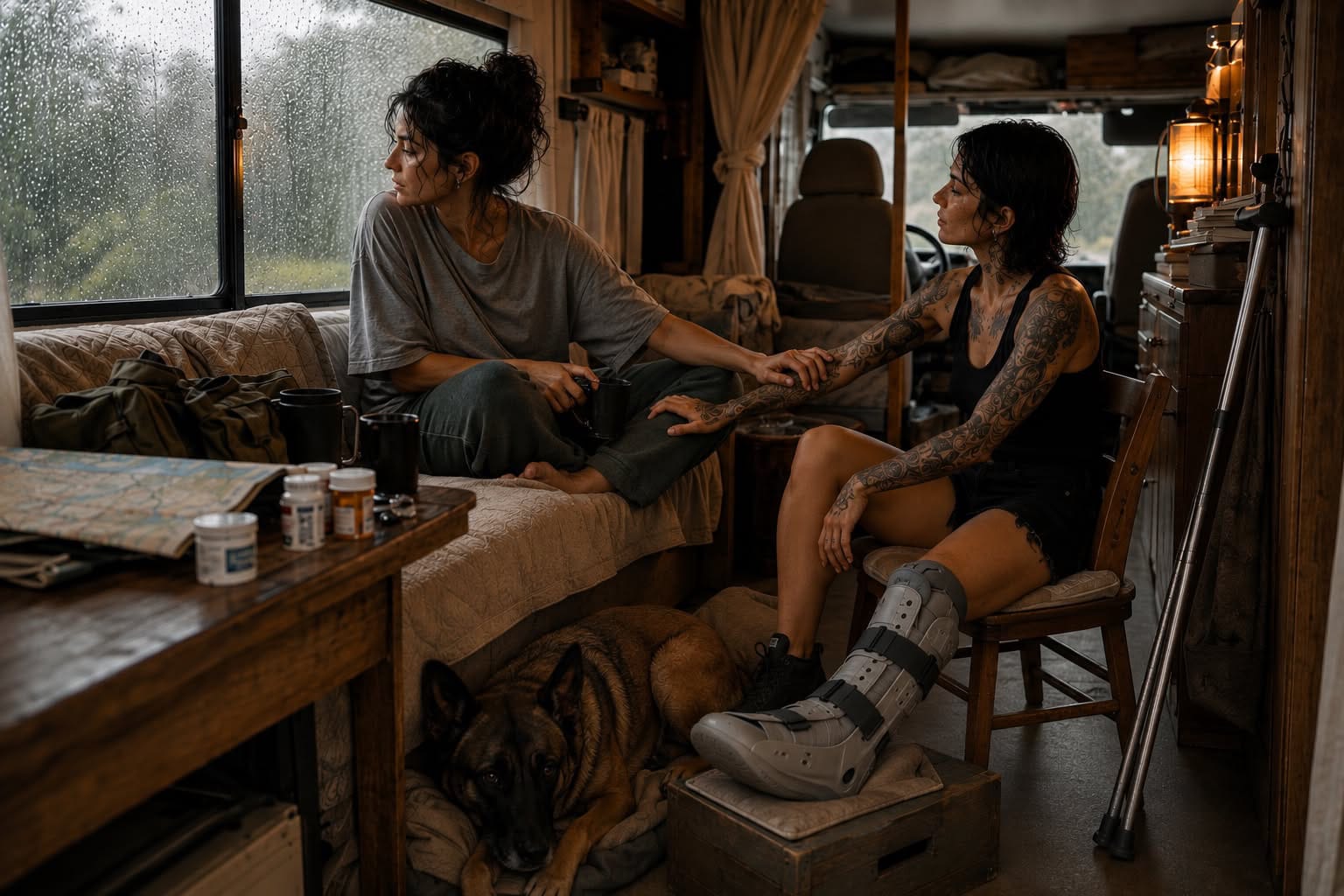
Valerie’s accident. I already knew people cared about Clara and Valerie, but after the accident I started receiving messages asking me to please stop making them suffer. Some were basically: “Fernanda, haven’t they been through enough?” And that made me stop and think. Not only because I realized how protective people had become of them, but because it made me think about the kind of story I wanted to tell.
It would be easy to let Clara and Valerie simply be happy together and protect them from anything that might hurt them. And I understand why readers want that. When you love characters, you want them to be safe. But I don’t think that’s the story I’m interested in writing. For me, love becomes most interesting when life refuses to make it easy. What happens when loving someone doesn’t protect you from fear, loss, illness, change or the possibility that everything can suddenly go wrong? Who are you to each other then? Do you still choose each other when love can’t fix what happened?
I don’t make Clara and Valerie suffer because I think pain automatically makes a story deeper. It doesn’t. And I never want suffering to exist just for shock. But I do want life to happen to them. Because then the happiness matters too. The ordinary mornings matter. The stupid jokes and pranks matter. The coffee, the ocean, the quiet moments when nothing is wrong — they all carry more weight because both the characters and the readers know they aren’t guaranteed. And somewhere in the reaction to Valerie’s accident, I realized the readers weren’t simply waiting to find out what happened next.
They wanted me to protect these women. That was the moment I thought, “Wow. They really do care about them.” And I think the strange responsibility of writing characters people love is knowing that sometimes you have to hurt them… while understanding completely why everyone is asking you not to
You mentioned that seeing readers become part of the world through social media has been one of the most beautiful surprises. What does that community look like from your side of the screen?
From my side of the screen, it doesn’t really feel like an audience anymore. That’s probably the most beautiful part. There are names I recognize immediately now. People from completely different countries and backgrounds who somehow ended up meeting in the same little corner of the internet because of two fictional women. There are inside jokes, ongoing conversations, people teasing me about things I’ve done to Clara and Valerie, people talking to each other in the comments - and moments when I’m creating something and already know exactly who is going to lose their mind when they see it.
What I love is that people engage with the world rather than simply watch it from a distance. They notice tiny details. They remember things from months ago. They have theories, interpretations and running jokes. Sometimes an idea from the community becomes the starting point for a fun little visual or an extra moment outside the actual story, and I love being able to play with them that way. But the story itself is different. High Tides isn’t shaped by what people want me to do with Clara and Valerie. I listen to readers, and I love hearing how they see the characters, but where the story goes and who Clara and Valerie are has to remain true to the story I set out to tell.
I think that separation is actually what makes the community side so much fun. There’s this whole space around High Tides where we can joke, imagine things and enjoy these characters together without changing who they are or where their story needs to go. And maybe the biggest surprise of all has been the kindness in that space. I’ve watched people who met through High Tides start recognizing each other, joking with each other and supporting each other. A comment becomes a conversation between people living thousands of kilometers apart. Sometimes I just sit there reading everyone talking underneath something I posted and think, “How did this happen?”
Because from my side, I don’t see a follower count. I see names. Personalities. Running jokes. Familiar little profile pictures. People who have somehow made room in their lives for this world I created. High Tides may have started on my side of the screen. But it definitely doesn’t live only here anymore
Are there things readers notice about Clara or Valerie that you didn’t consciously put there when you were writing them?
Absolutely. And I think there’s an important difference between readers noticing who Clara and Valerie are and readers finding their own meaning in them. I know these characters. I know Clara’s history, why she makes certain choices, what she fears and what she would never admit. I know Valerie’s contradictions, her limits, the things she would never say out loud. There are things about both of them that I know even if they’ve never appeared explicitly on the page. But readers bring something to them that I can’t bring: themselves.
Someone will talk about a reaction Clara had, or something Valerie did, and interpret that moment through their own experience. Sometimes I’ll read it and think, “That’s not what I was consciously thinking when I wrote it… but I completely understand how you got there.” And I love that. Their own experiences can make them notice a particular silence, gesture, fear or reaction in a completely different way. They can find meaning in a moment that wasn’t consciously in my mind when I wrote it, without that changing who the character actually is.
I think I used to see intention and interpretation as being much closer together than I do now. I know what I meant when I wrote the words. I know who Clara and Valerie are. But I don’t get to decide everything those words can mean to someone else. And honestly, one of the most fascinating parts of sharing High Tides has been watching someone hand me back a scene I wrote — still the same scene, still the same characters — and seeing it through their eyes for a moment.
There’s something very intimate about following a fictional couple through short videos and images between reading chapters. Do you think that changes the relationship readers have with the characters?
I think it does — and sometimes in ways I didn’t expect. The videos create a kind of familiarity that the chapters don’t. People get to see Clara and Valerie between the big moments. Making coffee. Annoying each other. Sitting together. Laughing at something stupid. Playing with Serefina. Just existing. And I love that, because it can make them feel less like characters you visit when the plot needs them and more like people whose lives continue when you’re not reading. But familiarity isn’t always the same thing as knowing someone.
A short video can show you how Clara looks at Valerie, but it can’t necessarily tell you everything behind that look. You might see Valerie behave a certain way without knowing the history that explains why she does it. Naturally, people fill in those spaces themselves. Sometimes someone who knows them mostly through the visuals will describe Clara or Valerie in a way that makes me think, “That’s interesting… but that’s not quite who she is in the story.” And I actually find that fascinating, because it shows how much context changes the way we understand a person — even a fictional one.
So I hope the videos create closeness, but also curiosity. I hope at some point someone thinks, “I’ve been watching these women for weeks, but I want to know why Clara does that. I want to know what Valerie isn’t saying.” And then they find the story. Because the visuals can let you spend time with Clara and Valerie. But the writing gives you the context to understand who they are and what they carry with them into those moments. Maybe that’s the relationship between the two for me: The visuals let you see them. The words let you know them.
If Clara and Valerie had Instagram accounts of their own, what would each of their feeds look like?
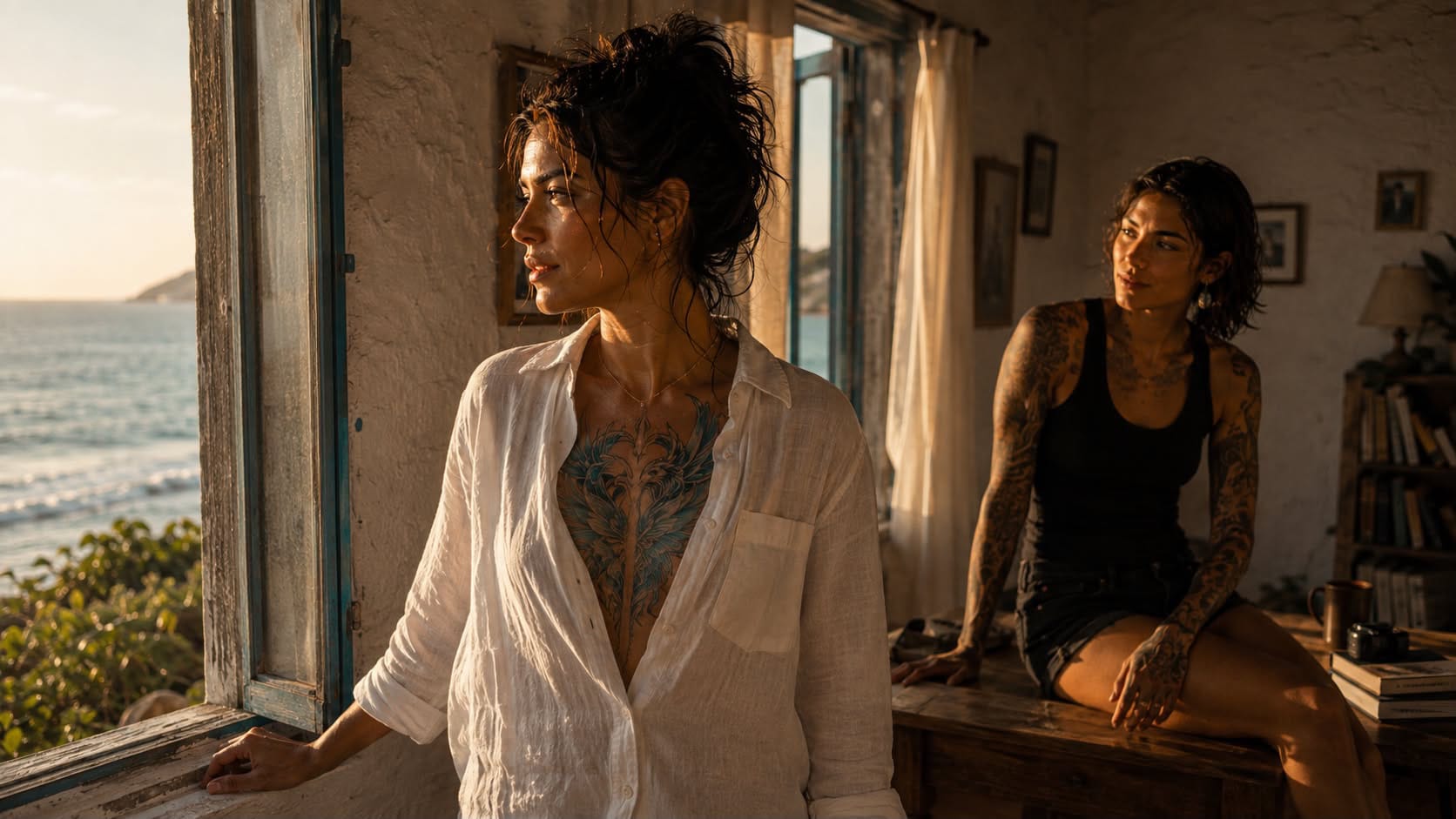
Clara’s would be very Clara: training, the ocean, sunrises, coffee, Serefina, places she’s been, probably some old photographs and random things she finds beautiful. And very little of Clara herself. You could follow her for months and still know surprisingly little about her private life.
Valerie’s feed would be tattoos, sketches, motorcycles, music, the studio… and Clara. A huge amount of Clara. Clara making coffee. Clara reading. Clara at the beach. Clara laughing when she doesn’t know she’s being photographed. Clara with Serefina. Clara doing absolutely nothing worth documenting according to Clara — and apparently something extremely worth documenting according to Valerie. And I don’t think Valerie would write long romantic captions under any of them. Maybe one word. An inside joke. Sometimes nothing at all.
So basically: Clara’s Instagram would show you everything she finds beautiful in the world without showing you very much of herself. Valerie’s Instagram would show you exactly what she finds beautiful. And most of the time, it would be her wife.
What part of the High Tides world have you loved creating that readers may not realise takes a huge amount of thought behind the scenes?
Probably the look, the kiss, the touch — and the feeling behind all of them. What matters to me isn’t making a kiss beautiful or a look intense. It’s making it feel right for that particular moment between Clara and Valerie. A kiss after fear shouldn’t feel the same as a kiss in the kitchen. A touch can be affectionate, playful, hesitant, protective, or carry something much heavier. And sometimes the most important thing in a scene is simply the way one of them looks at the other for half a second. But I never want any of it to feel too explicit.
I don’t want the gesture to explain the emotion for you. I want there to be something underneath it that you might notice — or maybe simply feel without being able to say exactly why. That’s probably where most of the work is. Not making the emotion bigger. Making it precise.
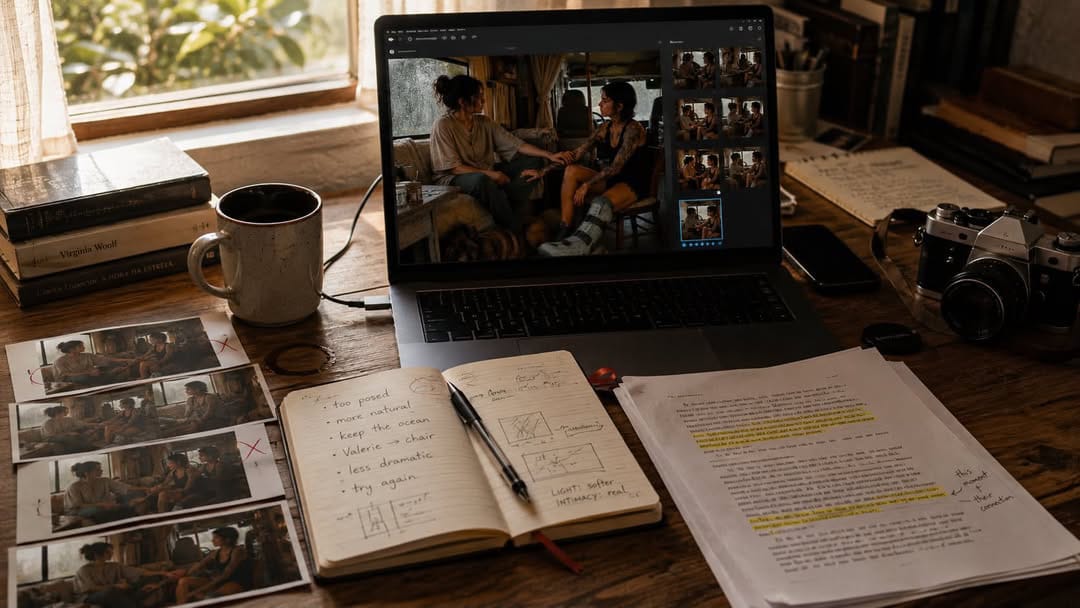
And those tiny details can take an absurd amount of time. A video that lasts about one minute took me almost two hours to make. Not because I needed more things to happen, but because I kept going back to those little moments — the timing, the look, the gesture, whether I actually believed what was happening between them. I’ve discarded beautiful images and videos because everything was technically right, but the feeling wasn’t. Because I don’t just want Clara and Valerie to look at each other. I want the way they look at each other to mean something. I don’t just want them to kiss. I want that particular kiss to belong to that particular moment in their story. And if I get it right, hopefully I don’t have to explain any of it.
Has building such a visual world made you think differently about what a novel can be today,not just something people read, but something they follow and experience across different formats?
Absolutely. And I don’t think I understood that possibility when I started High Tides. I started with a story. That was it. I wasn’t thinking about building a visual world around it or about people experiencing Clara and Valerie in different ways between chapters. That part happened almost organically. And somewhere along the way, I realized that a story doesn’t necessarily have to stop at the edge of the page.
It can spill out of it. A chapter can end, and the next day you see Clara and Valerie having coffee. You can watch a tiny moment between them that would never need to exist in the novel. A song can suddenly become connected to a scene. A visual can make you notice a detail differently. Then people meet in the comments and keep talking about something long after I’ve posted it. The story is still the center of all of it. I don’t think any of those things replace the experience of reading, and I wouldn’t want them to. But they can make the world around the story feel alive in a completely different way.
That’s probably what has changed for me. I used to think much more in terms of writing a story and someone reading it. Now I think there can also be this space around the story where people can visit it, talk about it, see little pieces of it and stay connected to the characters even when they’re between chapters. And I find that incredibly exciting. Not because I think every novel needs images, videos, music or anything else. Some stories should exist entirely on the page.
But High Tides taught me that a novel can become the center of something larger without losing what made it a novel in the first place. The book tells the story. Everything around it lets that story keep breathing between the pages.
If someone discovered Clara and Valerie through one of your videos tonight and had never heard of High Tides before, what would you hope makes them want to stay with them?
Curiosity. I think that’s what I’d hope for first. Not necessarily “I love these characters” after one video, because they don’t know them yet. I’d rather they watch Clara and Valerie for a few seconds and feel that there’s something there they haven’t been told. Why did she look at her like that? Why did that tiny touch feel important?
What have these two been through together? Why does it feel like I’m arriving in the middle of something that has been happening for a very long time? If a video can create those questions, then I think it has done its job. I don’t want to explain Clara and Valerie in sixty seconds. I couldn’t — and honestly, I wouldn’t want to. I’d just want someone to sense that history.
To look at them and understand that the kiss they’re seeing isn’t their first kiss. That a hand resting somewhere might mean more than it appears to. That there are things these two women already know about each other that the person watching doesn’t know yet. And maybe that makes them stay a little longer. That’s really all I’d hope for. Because I don’t think someone needs to immediately understand High Tides or fall in love with Clara and Valerie. They just need to feel like there’s something worth discovering. And maybe think: “Wait… who are these two?”
And one slightly unfair question to finish: if you could only keep one Clara and Valerie moment (written, filmed or visual) which one would you save, and why?
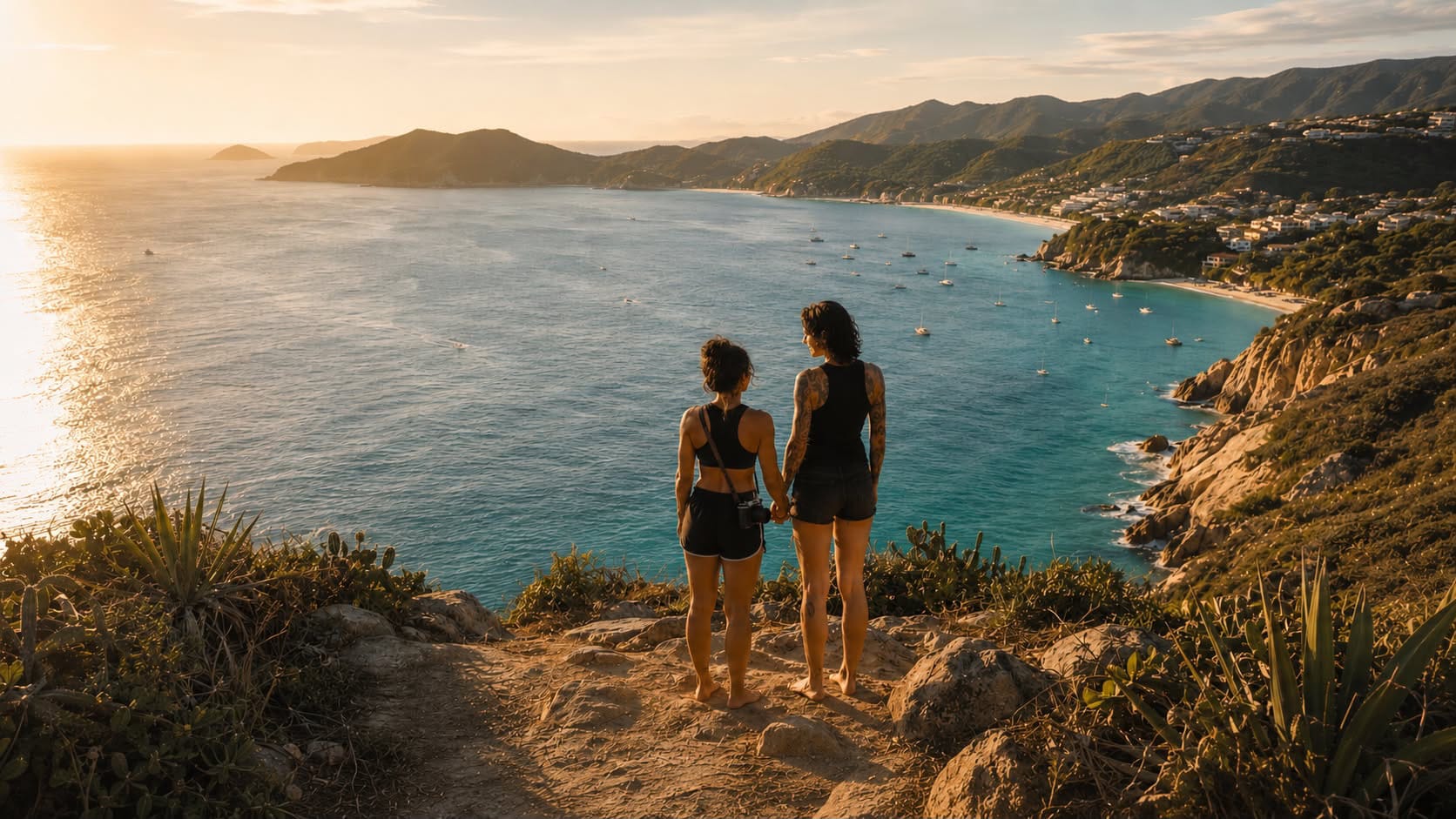
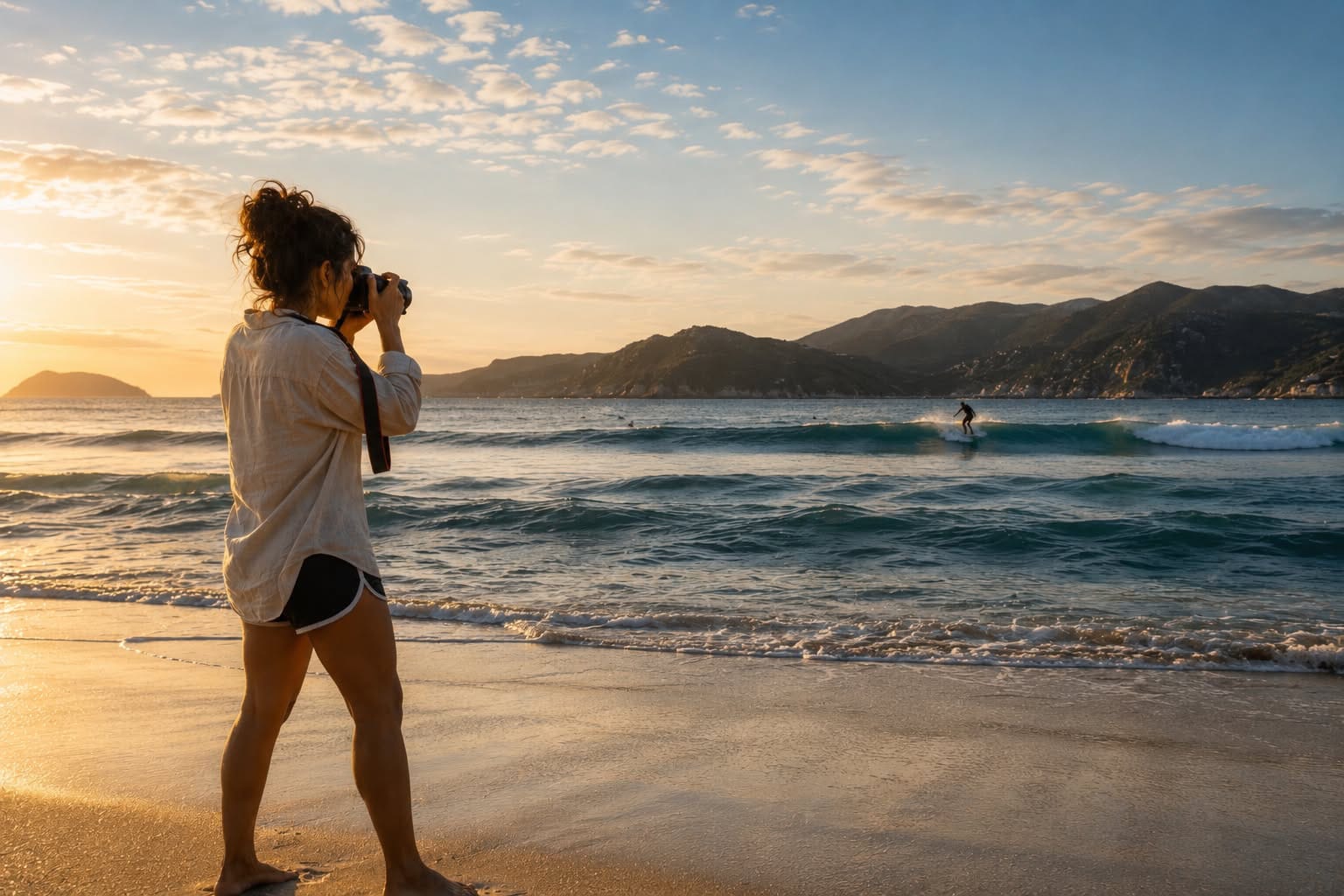
I’d save the very first scene I imagined when I started writing High Tides. Valerie is surfing, and Clara is standing on the beach with her camera, taking pictures of her. It sounds like such a simple moment, but when I look at it now, I realize the whole story was somehow already there. The ocean. Freedom. Valerie out on the water, completely in her element. Clara on the shore, watching her. That quiet connection between them. And this enormous, unpredictable ocean surrounding everything.
The ocean was there before I really knew what High Tides was going to become. And in a way, it was already the story. It can be freedom and danger. Stillness and chaos. Something that carries you and something you can’t control. It changes constantly, but it’s always there. So much of Clara and Valerie’s story would eventually become about exactly those things.
And maybe that’s why that first image means even more to me now than it did then. There are bigger moments in their story. More romantic ones. More painful ones. Moments that changed them forever. But if I could only keep one, I’d go back to that beach. Valerie on the water. Clara behind the camera. The ocean in front of them. Everything still possible.
I didn’t know then where they were going to take me. I just knew I wanted to follow them. And all this time later, I still do. Maybe the ocean knew before I did. That’s why it was always going to be High Tides.
SoapLandTV will continue following High Tides as Clara and Valerie’s world develops across its written and visual storytelling. You can discover more creator interviews, AI-created series and wider coverage through our AI & Entertainment section, while the latest High Tides videos can be found through Neuralafterglow on YouTube.
Sources: SoapLandTV exclusive written interview with Fernanda, creator of High Tides, August 2026.